
Key messages for strengthening future pandemic preparedness
Outcomes of the WHO Foresight Initiative
Being better prepared for the next infectious threat requires a mindset shift. We must adopt different approaches than those we have used before. Foresight can support the transition from emergency response to proactive infectious threat planning and management.
Through a series of conversations with stakeholders, three pillars were established as the overarching guiding principles to strengthen future pandemic preparedness efforts: (1) Trust (2) Solidarity and Equity (3) Sustainable Development. Five themes were identified as areas of focus. Each area of focus includes clear practical ways forward. These are key in formulating an all-encompassing approach when managing and responding to the complexity of infectious threats.
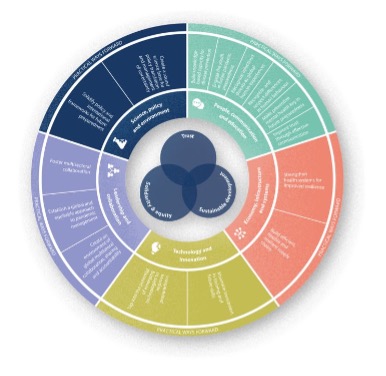
A summary of the five themes can be found below:
- Science, Policy and Environment. A sound scientific evidence base must be developed and communicated, informing transparent knowledge translation across policy and practice with a goal to master decent management of uncertainty. WHO should lead the development of research agenda, with increased attention to science for equity.
- People, Communication and Education. Infectious threats are global human experiences that start and end in communities. Engagement for preparedness includes fostering trust and actively engaging communities to protect the health and wellbeing of their members.
- Economy, Infrastructure and Systems. Strengthened and resilient systems are necessary to respond to shocks, both known and unknown, to save lives and livelihoods, while ensuring ongoing essential services across sectors. We need to design organizations, institutions and systems for a desirable future and fund them accordingly.
- Technology and Innovation. Technology and innovation play a key role in realizing ambitions regarding future preparedness. Advancements in genomic science and nanobiotechnology must
be leveraged to achieve pan-viral prevention.
- Leadership and Collaboration. There is a pressing need to champion equity, foster trust, and to uphold transparency and accountability in the highest levels of decision making. Data, knowledge and solution sharing are crucial to ensuring global solidarity.
To know more, read the report.